
 עברית
עברית
Or Ozerd – Lines of Change
Or Ozerd is a multidisciplinary artist who began her career designing sets for the theater and later worked as an art director on leading films in Israeli cinema. Throughout the years, the guiding artistic principle in her work has been the creation of narrative: reflecting artistic reality and telling a story through the design of sets and spaces.
In recent years, as a result of physical pain and limitations, Ozerd discovered painting as a means of healing.
“I wanted to be able to enjoy the simple things. A line, a stain, a splash of color. To do something that would divert my attention from the pain.”
Her first works were created from the sofa on the balcony of her home. Surrounded by plants, sitting or reclining in an armchair, Ozerd discovered the slowly changing world of vegetation. She observes its patterns and textures, allowing her imagination to delight in what her eyes perceive.
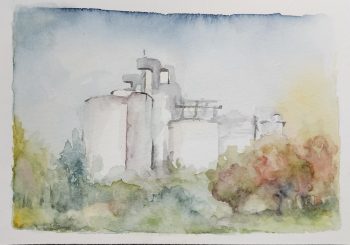
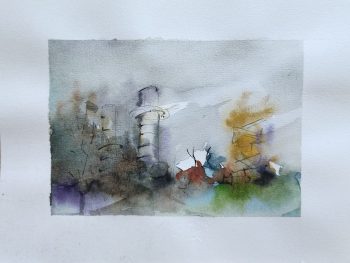
Ozerd explores painting through a variety of techniques. She began with pencils, pens, and markers in small formats, and later moved to watercolors and ink on rice paper. Gradually, a body of small-format works emerged from a natural need for beauty and color. A process of idealizing the visual experience developed into a form of poetic realism.
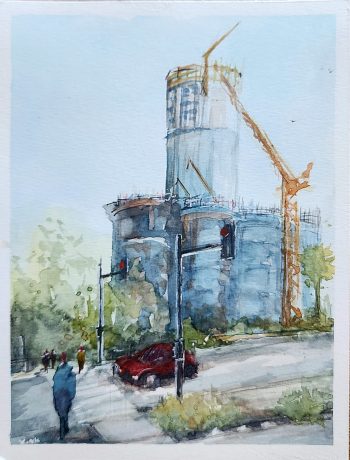
As her journey continued, the series “Vacation Postcards” emerged, born out of small victories of movement through the world—small islands of freedom from the isolation of home. Photographs taken from a moving car form the basis of the series, which expresses ideas and thoughts concerning the perception of domestic space, literal and metaphorical holes, and the encounter between human narrative, material, and space.
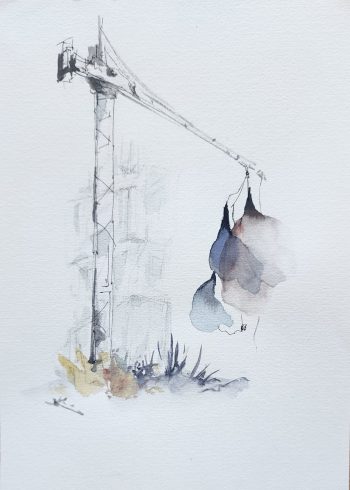
The distance between destinations once experienced casually, and the seemingly ugly landscapes of roads, cranes, and chaos, is transformed through isolation into a landscape and a space for curious contemplation. The series reflects the pleasure found in urban growth alongside fleeting glimpses of nature seen through car windows.
It is a movement of constant change set against the body’s stillness.
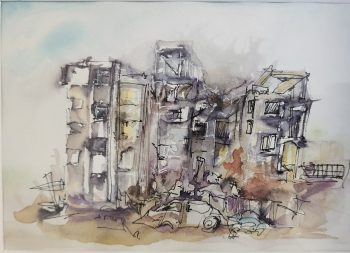
Buildings being dismantled, roads under construction, cranes, ladders, and structures being rebuilt—an urban landscape in constant motion, noisy and restless, destroyed and renewed. The gaze is distant, from within the passing car, and thus an art emerges from noise into silence.
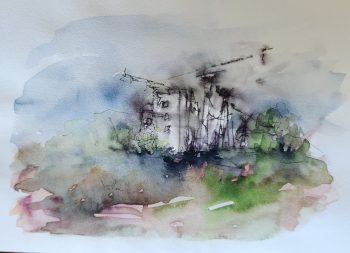
A fleeting gaze captures a moment—sometimes through photography, sometimes engraved in memory—and is then given emotional expression and depth through painting. The painting takes shape before the viewer’s eyes, preserving the fleeting moment.
As Ozerd explains:
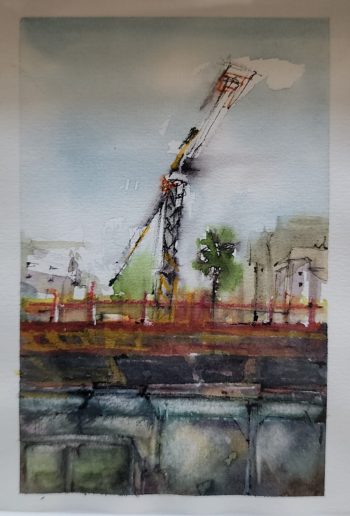
“Leaving the house was a kind of battle within the struggle against pain, but it was also an enjoyment of spaces and sights that were not home. The world grows, changes, falls apart, is destroyed, and is rebuilt, and I allowed my imagination to enjoy what I saw.”
The works on display create a kind of idealization of destruction and dismantling, of chaos, noise, and dirt. The distant gaze, preserved in painting, deepens and anticipates what will emerge after destruction: growth, renewal, and beauty.
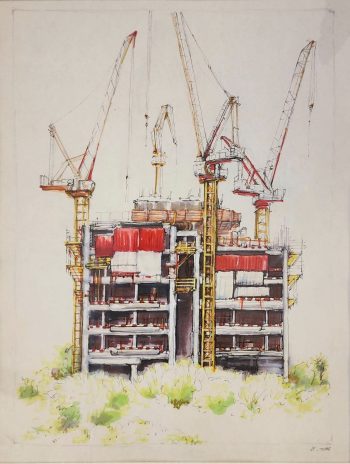
Painting discovers beauty within destruction and chaos. Concrete skeletons, steel columns, and cranes merge with the natural landscape, creating a visual idyll in which beauty and danger converge. Structures become living organisms—crumbling and growing at the same time.
Large and small openings become filled with the potential for human existence, while shutters and balconies reveal glimpses of the human stories inhabiting them.
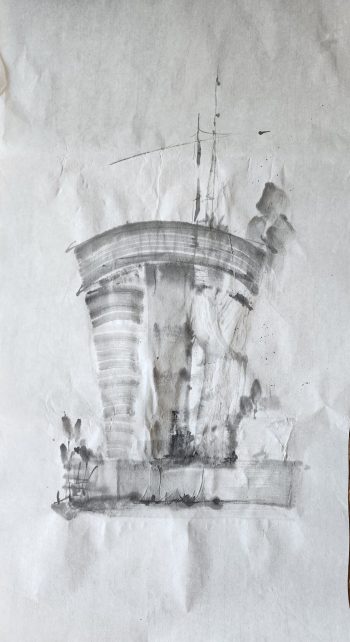
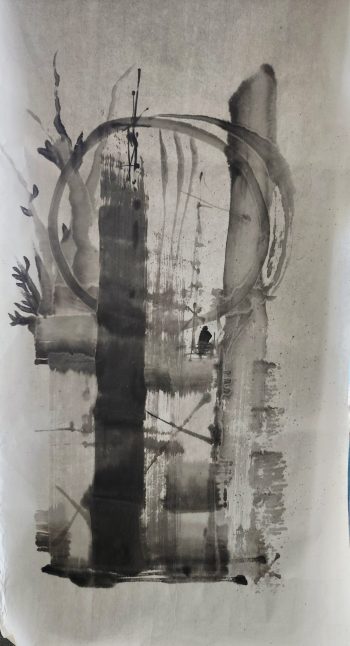
A further series presented in the exhibition was inspired by Sumi-e, a traditional painting technique using black ink on rice paper. Originating in China, it was later introduced to Japan in the 14th century by Zen Buddhist monks.
Sumi-e is a minimalist, meditative painting technique in which the artist seeks to capture the spiritual and inner essence of the subject through a minimal number of brushstrokes. Rice paper absorbs the ink rapidly, leaving no possibility for correction or erasure; therefore, each brushstroke is final.
Ozerd creates a minimalist, meditative series on rice paper, sometimes using only black ink and at other times incorporating watercolors as well.
She describes the series:
“This series is a window into my personal world, into my associative world. It connects to my search for my place in nature, and to my place as a woman in this world.”
The paintings reflect a personal gaze and a longing for nature and the outside world from within the constraints of physical limitation. They are a collection of moments of freedom beyond the walls of home.
Dr. Galia Duhin Arieli
Global Art Gallery
13 Ba’alei HaMelakha Street, Tel Aviv
Tel. 050-281-1710