
 עברית
עברית
Israeli Art
Gathering Memories – Michal Zakai, Solo Exhibition
“To paint memories is essentially to paint something from the inner world of life. Although at first glance I may be dealing with outward scenes, landscapes and nature, in fact I am painting inner visions. My painting is a transformation of an experience that passes through the soul, evoking memories that arise within me in a process that is both conscious and unconscious. These memories give my art its emotional quality, linking the work to my personal biography and to the inner world that is deeply bound to the world of the home.”
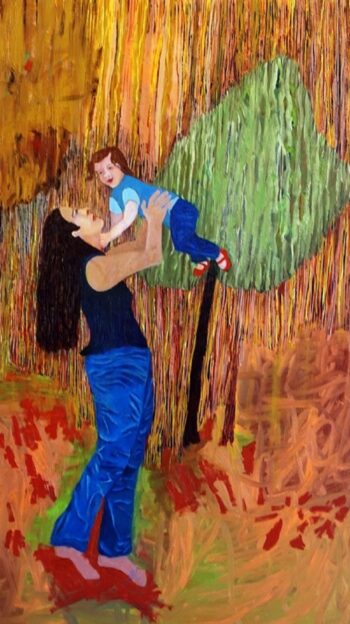
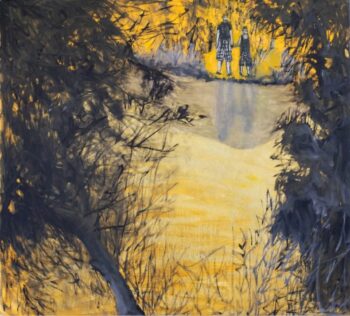
Zakai’s sense of home is deeply tied to Kibbutz Shamir in the north of Israel, located very close to the Syrian border. Nature was an inseparable part of her childhood memories. The trees, swaying violently in the stormy winds of autumn and winter, threatened with their force, yet in the scorching summer provided shade to anyone who sought it. The bubbling springs, hidden in shrubbery, cloaked in secrecy and mystery, were both calming and frightening. “We would recline by the spring and enjoy ourselves, yet always with the awareness that from the thickets at any moment a venomous snake or a deadly scorpion might suddenly emerge.
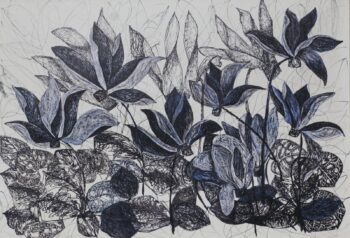
“ This duality—peace alongside fear, calmness in contrast to danger—was intensified by the very real danger of life in a kibbutz so close to the Syrian border. “Every walk into nature was accompanied by fear of Syrian soldiers positioned on the border and on the surrounding hills. This complexity was an inseparable part of life in the kibbutz and the nature around it, and it is reflected in my art all along the way.”
Zakai’s artistic path began with years of study under Rachel Shavit Nentoich, a well-known artist and one of the founders of the “Climate Group,” which was active in Israel in the 1970s. The group emphasized attention to local light, color, and landscape. Her primary painting style at that time was realist, oil on canvas, based on deep observation of objects in reality—not from photographs that had already undergone a form of transformation.
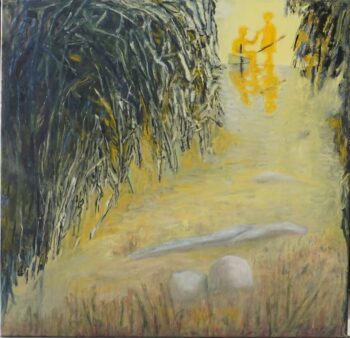
Later she studied with artist Nadav Weissman, an interdisciplinary artist, through whom she gained insight into the relationship between background and image. With him, the way opened to break the boundaries of the image. Her painting became more collage-like, with freer connections. Under his influence, colors began to flow from the background into the image and from the image into the background, although the boundaries remained clear.
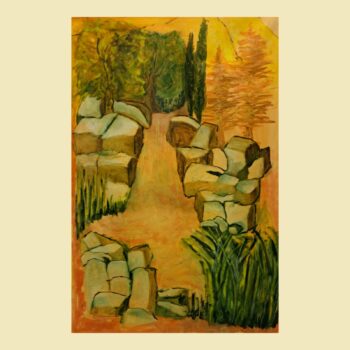
In recent years, under the guidance of artist Boaz Leventhal, her practice has developed towards creating soft transitions (soft edge) between background and image. In addition, Zakai has worked for many years in close collaboration with Meirav Shin Ben-Alon. “Together we engage in a deep observation of art and of myself as an artist within the art, aiming to understand all the types of art that exist within me.”
Zakai describes her process: “My work begins with an idea that simmers in my mind for a long time. The idea accompanies me everywhere, for an extended period. What do I want to express? In what format, in what size, what will appear on the canvas? Then comes the stage of creation, and even then nothing is final. Everything can change—the colors, the technique, the size—everything. Then comes a stage that feels like a kind of happiness. I sense that something good is happening now. At that point, I say to myself: Okay! Apparently nothing more needs to be added. From that moment the artwork leaves my hands and passes on to the viewer.”
Zakai explores the world of the inner and outer home, the blending of inside and outside. The landscapes in which she grew up, the personal and communal sense of home in the kibbutz, are all reflected in her art, touching not only her own personal memories but also those of the viewer. These are landscapes, images, and the world of home and family, which anyone with open eyes and heart may encounter and be moved by, anywhere and anytime.
Michal Zakai Today
Michal Zakai is an artist who continues to learn, experiment, and explore new and exciting fields in the world of art. Soon she will publish a book presenting three groups of works, all of which move between the personal and the universal, between body and memory:
- Embroidery-like drawings exploring the emotional connection between parents and children – a delicate line of thread tracing intimacy, gazes, and distances.
- Oil paintings portraying the home as a biographical arena of rooms, objects, and patches of color that return to childhood memory and feminine identity.
- The “Genesis” series, consisting of nine works in the form of a womb, based on ultrasound images from stages of pregnancy. These works combine scientific imagery with the bodily and emotional experience of life’s formation.
Together, the three series form a visual diary of body, roots, and continuity.
Dr. Galia Duchin Arieli
Global Art Gallery
13 Merkaz Ba’alei Melacha, Tel Aviv
August 19, 2025 – September 20, 2025
Grand Opening – Saturday, August 23, 2025 at 12:00